Genre Trouble
Or: the Limits of Vampires

I started this entry in Seattle for WorldCon, taking a break from the convention to cool off from a humid, misting day in the Central branch of the Seattle Public Library, which is as dramatic a piece of architecture as anything in the downtown core. Construction was completed while I was living in Seattle, studying for a library degree, yet I’ve never managed any particular attachment to the building. I appreciate its boldness and commitment to absurdity. From the inside, it’s a vertiginously open shrine to books and empty space.
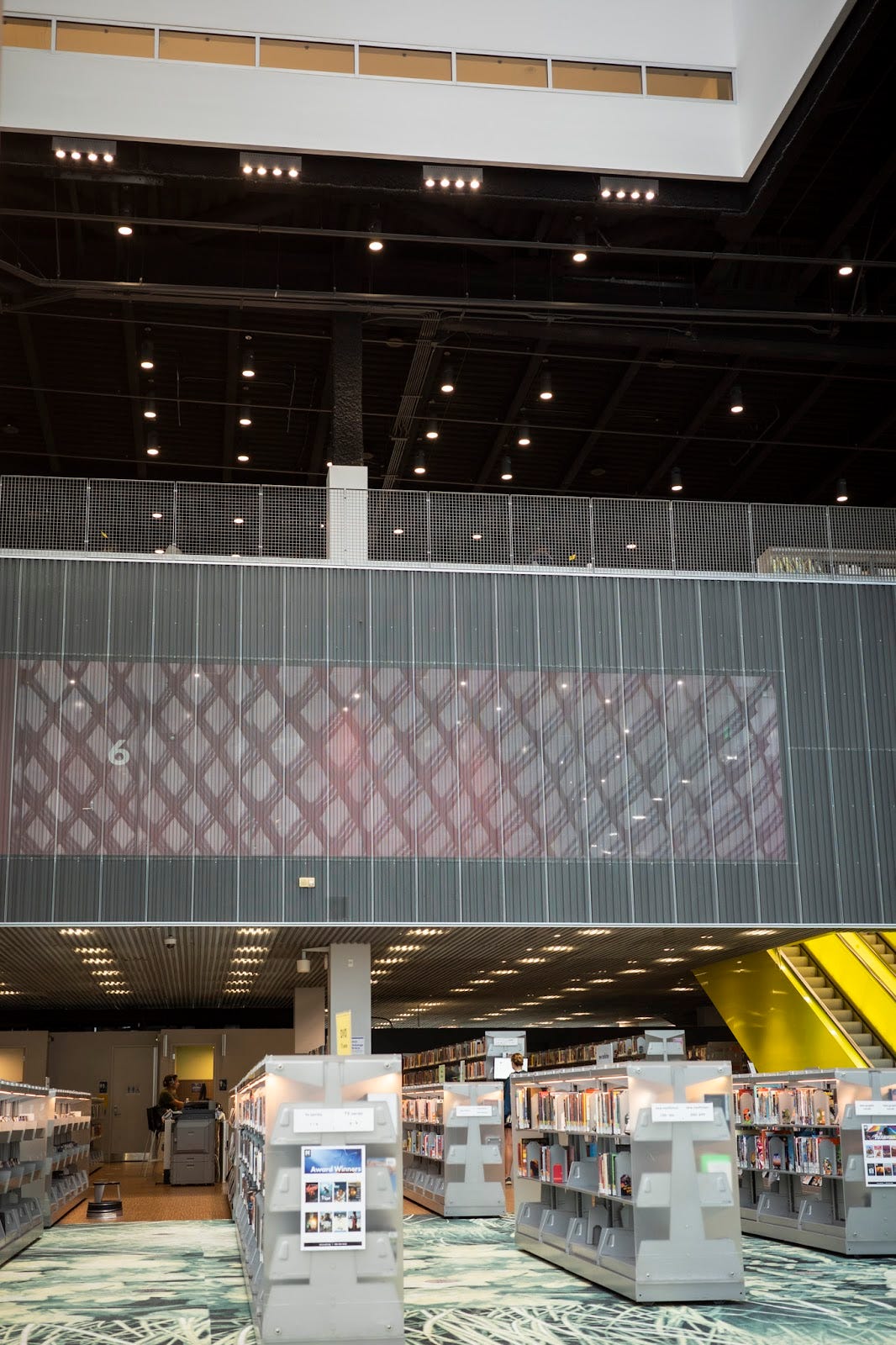
From the outside, it looks like a glass pyramid in fishnets, dressed to go out to a nightclub for skyscrapers.

The best is the view between, looking up at skyscrapers from inside a sexy metallic lattice.

The setting for this entry is irrelevant, but it’s worth celebrating how wonderfully batshit this building is.
Stepping away from WorldCon, an enormous science fiction convention (though its programming includes significant fantasy, horror, and cross-genre sessions) to write an entry beginning to pick apart my complicated feelings about genre. I just attended a session about the horror of surviving in isolation, particularly in nature, where the antagonist is the total indifference of the world.
A meandering aside in the panel’s discussion was whether such a scenario even required a supernatural element, or whether simply surviving against the world generated enough drama to warrant a story. As panelist Eugenia Triantafyllou put it (I’m synopsizing here) a natural setting might be tense enough to carry the story on its own, sure. But also she just likes zombies. (In particular, the ways that the supernatural can play with the natural.)
Hence, today’s micro-obsession: where does it make sense to include genre, where can it assist a story’s themes, and where does it hijack them?
“Sword Talk” is the Name of My Next Podcast
I’ve been mulling this entry since reading M. John Harrison’s Essay “The Profession of Fiction,” from 1992’s The profession of science fiction : SF writers on their craft and ideas. In this essay, Harrison reviews his own literary career, discussing how he started out attempting to deconstruct and subvert the tropes of fantasy, but ultimately has decided to shift away from explicit genres. (Note that this was his perspective after 30 years… and he’s written for another 30 since. #exhaustingLifeGoals)
His claim in this essay is that genre tropes exert a gravity of their own, and that attempts to subvert them lose out to the tropes themselves. Put another way, speculative elements are so divorced from the lived experience of people that they fail to serve as an effective allegory for that experience. As Harrison puts it:
But in the end the subject-matter of popular fiction has an inertia, a doggedness, we could never have predicted. The interstellar drive “says” only itself. The only emotional charge the sword carries is its own swordness. These stock units overbear the metaphors you try to make with them, so that when for instance Gene Wolfe speaks of swords and torture he does not twist the genre against itself at all… he only speaks of swords and torture… If you want to speak directly about – or to – what is human in people, it’s no good learning sword-talk. (pp. 141-143)
I don’t fully agree with this perspective. Speculative elements can serve as allegories for experience. E.g., an alien parasite can be written as a reflection on poisonous ideas living in your consciousness; werewolf and vampire stories tell of othered peoples passing within society until they can’t; the entire library of A24 has taught us that literally everything can be a metaphor for trauma.
Additionally, the heightened situations brought on by speculative elements can say interesting things about social conventions or power structures. Hence the fact that every good zombie movie is actually about how monstrously people behave when threatened.
But there’s something to Harrison’s point: genre tropes can take over whatever emotional truth you were getting at when writing the story.
Harrison’s solution is what he refers to as the modernist mode, which I would describe as simply writing directly (or indirectly, in a realist style) about the subject of the work. If you want to explore grief, write about someone grieving. You don’t need a ghost, and in fact inserting a spirit can be distracting because of the ways it draws the reader’s attention away from the vivid rendering of lived experience. “What modernism can give you is a surprising sense of what it’s like to be inside your own life. For a second you are encouraged to reinhabit yourself.” (143)
Harrison points to Victor Shklovsky’s description of this from his 1917 essay, Art as Technique. Shklovsky’s position is that the human mind naturally attenuates to every experience, robbing it of immediacy. He refers to this as habitualization, which:
devours work, clothes, furniture, one's wife, and the fear of war. "If the whole complex lives of many people go on unconsciously, then such lives are as if they had never been." And art exists that one may recover the sensation of life; it exists to make one feel things, to make the stone stony. The purpose of art is to impart the sensation of things as they are perceived and not as they are known. The technique of art is to make objects "unfamiliar," to make forms difficult, to increase the difficulty and length of perception because the process of perception is an aesthetic end in itself and must be prolonged.
This position valorizes art that uncovers new meanings or new perspectives in the everyday, bringing novelty to the known. Looping back to Harrison: stop looking for metaphors of things and just write about the thing itself! If you want to write about being gay in a hetero marriage, your story doesn’t need a doppleganger that’s better at playing at the rules (or breaking them). Just write about bathhouses and sweat and guilt and excitement.
The trouble, of course, is that doppelgangers are inherently interesting.
A Cocktail of Real and WTF
Since returning to writing, I’ve struggled with genre. At WorldCon (as at other speculative fiction conferences I’ve attended), I’ve admired the writers who seem to be able to so readily write toward the expectations of a genre. Write dragons and heroes and wizards and villains. (Lincoln Michel just wrote compelling about this—the ways that writers in a genre, even when subverting expectations, are doing so in conversation with other authors in that genre, living and dead.)
Saying I struggle with it sounds like bragging, as though I’m laying my hand on my forehead faintingly, saying, “Oh how I wish I could be commercial, but my art is just so idiomatic.” But really, I think it’s more like pathological demand avoidance. That is, it’s not actually healthy or useful.
A normal response to thinking about a story about mummies is to imagine the creative possibilities of the form. Is this a story about museum grave-robbing and cultural theft? Colonial extraction? Hubris of the archeologist or the mummified? Is its attention on the mummy or the victims? Is its tone horrific, campy, or reflective?
My response is to dismiss everything salient about the subject. “What if they weren’t royalty and there wasn’t a curse and they weren’t wrapped or recovered from tombs (and also weren’t mummies)?” The results are occasionally interesting, but usually… useless, I think? Last year, there was a call for stories about Circe. I wrote a story of someone meeting her and questioning, when a legend is embodied, who has the right to tell her story? How would doing so transform and reduce her? It wasn’t materially about her legend, nor even retelling it; it just questioned the ethical foundations of mythmaking.
It’s as though someone told me to write a story and I said, “You can’t tell me what to do!” Even had it been more traditionally structured (my story lacked stakes), it wouldn’t make a good addition to a collection of stories about Circe.
I’m back to gnawing at this as I poke away at revising my novel. It begins in a realist-enough vein: two emotionally guarded people meet and charm each other, then spend a few weeks flirting via text. They each consider how much of their perceptions of each other is optimistic fantasy, how intimate they are willing to be, how willing they are to reveal issues that might undercut the building relationship.
Then they are infected by some supernatural force that connects their emotions and sensations, such that they must evaluate how much forced openness they can handle, and whether their feelings are actually their own vs. simply being mirrored from the other. You know. Normal relationship stuff.
I want the premise to let me work through questions of agency and consent. The supernatural aspect lets me elevate and literalize what it’s like to become enmeshed with a near-stranger. The thrill and discomfort that comes with vulnerability. The excitement of shared sensuality alongside the fear that such porous boundaries engender.
Then, in the third act, we dive into the source of the supernatural connection. Unpacking that, we get a surreal wander through a subterranean community. It’s where I’m hung up in the revision. It gets weird, y’all. But I love weird. (Triantafyllou, on the panel earlier: “But I love zombies.”) Any number of paths of revision are acceptable here, but it’s a fact that, in this initial draft, the emotional experience of the characters becomes subordinate to the speculative elements. My intent is defamiliarization – here via a sort of dissociation as their respective identities are subsumed by the community and each other – but you need the familiar for that to work.
My hope is that the supernatural provides a frissive counter to the inhabited character moments, but the fact is that the more I dive into plot the less I explore the experience of inhabiting the world. I want to be writing a weird meditation on entwinement and fear. I want to make the stone stony, but I’ve fallen into sword talk.
Oh No Another Substack Entry on Sinners
Sinners offers an interesting example of a text in which genre conventions overtake the story, but in which that’s generally the point. One day I might write the five or six entries on Sinners that represent a sliver of the conversations I’ve had about that movie. For this entry, I want to focus on the way genre functions in that film.
Mild spoilers about the premise and shape of the film forthcoming; you can skip to the next section if you haven’t seen it.
In that film, two charismatic, relatable, and morally compromised brothers return to the town they grew up in to set up a juke joint. I could have watched a whole film of the first 45 minutes, the way they schmooze and bribe their way through the community to gather their staff, the way money and power function within and between the characters they meet, the push-pull between their mercenary ambitions and the ways they built a place for the community to gather. It rules.
Then vampires show up and it all goes off the rails.
I mean this in several senses: the plans of all the characters are jettisoned, but also the central tensions of the film essentially vanish. It moves from being a movie about these nuanced tensions and instead becomes a movie about vampires.
The vampires rule, though. It is directly about colonization and appropriation, with villains who are themselves victims reclaiming their power. There’s the required “come join us” speech that is easily the most convincing in any film I can remember. I was completely persuaded. (Their rhetoric is similar to that of rioters in 2020: when the social contract has so comprehensively failed you – and indeed is architected to suppress you – why wouldn’t you burn down a Starbucks?) These vampires aren’t metaphors for social and historical forces: they are characters who experience those forces as much as any character would in a realist film.
To be clear: I love the vampires.
But still.
There was a hell of a movie that was devoured by vampires. An expansive cast of characters, each given an introduction scene that both hooked the audience into the new character and deepened our understanding of the other characters in the scene. By the time they all arrived on the dance floor, we had a sense not just of the implied depth of each character, but the complicated web of relationships between them. When the vampires showed up, we’d just begun to pick at the tensions and fissures within the community in ways that were exciting. Once the vampires are there–well, then that’s essentially the rest of the movie.
Horror in Sinners functions similarly to how I described it in several stories in The King in Yellow: an overwhelming force that wholly disrupts whatever tension or drama or values you thought you carried. In the above entry, I described how, in these stories, the speculative elements shows up and wholly disrupts the story you thought you were reading. So a sweet shopgirl romance derails into a horror. A dreamy, surreal story about a cat drops suddenly into a gothic mode. Horror behaves the way war does in the last story in that collection: a tidy drama about American expats in Paris is wholly shattered when the city is besieged, rendering their particular dramas irrelevant.
Vampires in Sinners functions like war descending on your home. Or your community being burned down. Once a force like that arrives, you don’t care whether people are paying with wooden dimes or what allowances we should have for unpredictable behavior because a person is dealing with trauma. Such events are obliterating.
Fantasy as Its Own Reward
The entry above takes a skeptical look at genre and how it can limit other thematic ambitions. But the fact is that these stories can be appealing on their own terms. I look at Sinners and wonder what a full-length film about that gin joint might look like, but I don’t know that I would have bought the ticket if I were told, “Ryan Coogler directed a stylist new period piece.” I didn’t see Creed because I’m not interested in boxer movies. But I did watch this because I’m interested in horror movies.
So I’m ambivalent about genre. I don’t think that the only art with any value is that which defamiliarizes. It can satisfy for many reasons. Werewolves might be allegories for rage or menstrual cycles or passing. Or they might be scary monsters that it’s fun to run from. Both make great stories.
It’s nice to attend WorldCon. I’ve seen a dozen different authors speak eloquently about their stories not purely in terms of their themes and plots, but with the themes and ideas they wrestled with. It’s been an excellent antidote to my sense that the tastes of the age run only toward self-referential tropes with no interest in communicating lived human experience. (That said, I’ve heard some pretty rad plots and premises.)
By this point I’m back home and close to catching up on sleep. Attend a convention, y’all! They’ll restore your faith in the enthusiasm of artists. And if you’re lucky you can get nice soups.

Stray Observations
Unfortunately, nothing I read in this week’s 1917 essay was as batshit as last entry’s 1916 essay on killing darlings that ends by encouraging readers to inherit “catholic manhood” from “great loins.” Apparently wartime literary essays were not all fixated on my prurient interests. If anything, Shklovsky’s essay started out blowing my mind but became progressively less interesting as it went along. Here’s hoping I’ll dig up some properly salacious Private Reading for future entries.
I described my own demand avoidance in the context of always wanting to write stories that reject the assignment. I suspect that’s part of why I adore that M. John Harrison essay. In a collection on the art of writing sci fi, he convincingly explains why one shouldn’t write sci fi. In the essay, he takes a well-meaning shot at Gene Wolfe. Wolfe’s contribution to this collection immediately precedes Harrison. I find it all so relatable and awkward.
I came to writing genre fiction from years of genre fiction buried deep in my brain. I find my stories just express themselves this way. Recently, I discovered Ursula Le Guin's essay, "The Carrier Bag Theiroy of Fiction," which really resonated with my sensibilities: https://theanarchistlibrary.org/mirror/u/uk/ursula-k-le-guin-the-carrier-bag-theory-of-fiction.pdf. It gives me hope that my view of humanity, and way of approaching stories, might just resonate after all.